Drone in a box: a UK guide for construction sites and ports
What a drone in a box actually is, what it costs, what the CAA will let you do with one, and how to tell whether it’d earn its keep on your site.
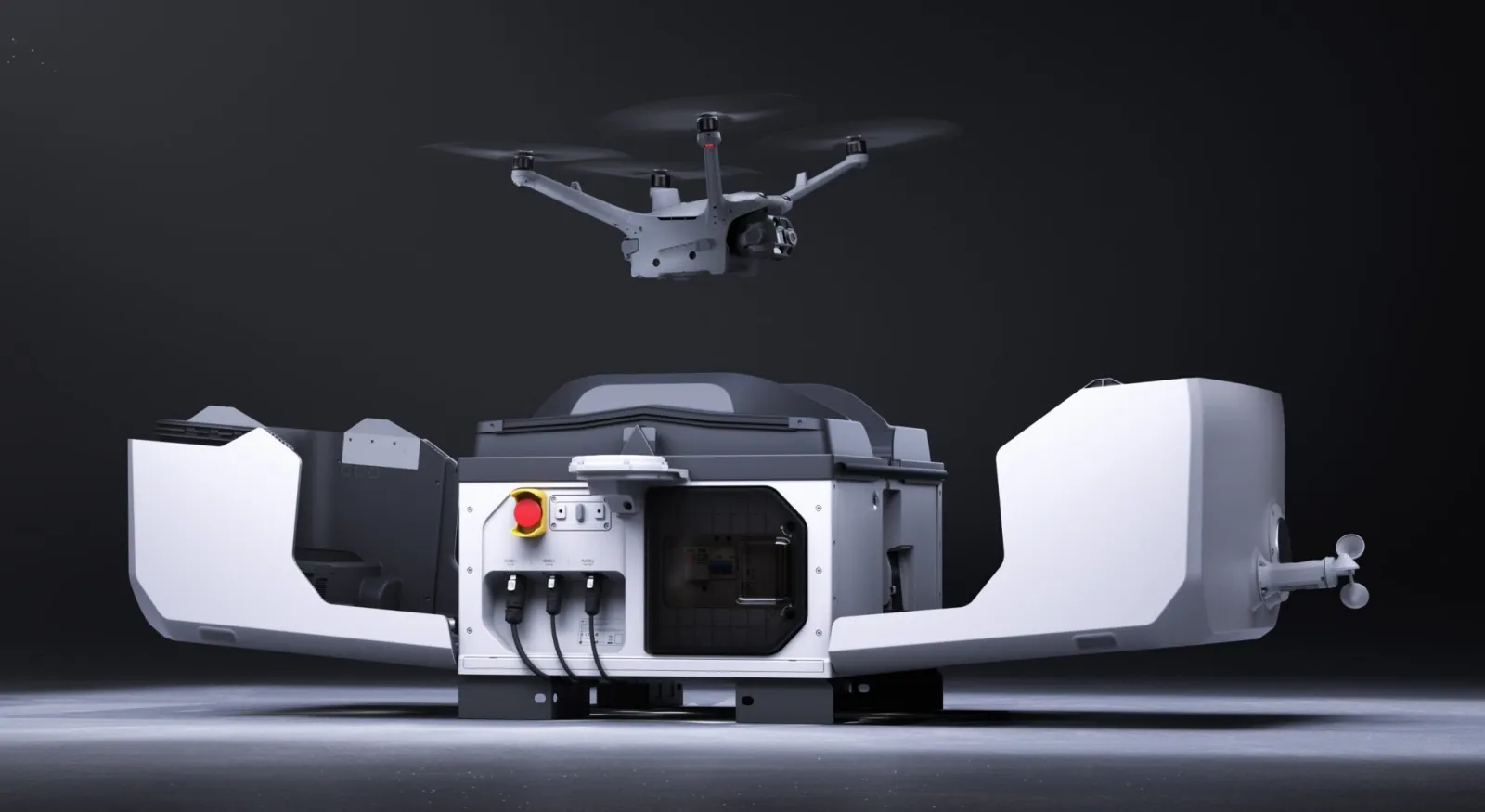
A site manager we work with told us recently that several companies had pitched him a drone in a box, and not one of them could make it work on his site!
He’s not alone. The kit’s clever and the brochures are glossy, but making the most of them takes planning and creativity. So here’s what we’ve learned, and how your media arsenal would be better for having one.
What is a drone in a box?
Picture a chest freezer bolted down somewhere on your site, wired into the mains and the internet, with a drone hibernating inside.
On a schedule you set (every Monday at 10am, say) the lid slides open and out it pops, like a very expensive cuckoo clock.
It flies a pre-planned route, grabs the same shots from the same positions it used last week, lands, charges itself, and uploads the lot.
Every Monday at 10am, this happens
- 1Lid opens
- 2Flies the route
- 3Grabs the same shots as last week
- 4Lands and charges
- 5Uploads the lot
Then the lid shuts until next week.
It’s also fussy about the weather (aren’t we all). The dock has its own wind and rain sensors, and if conditions are outside its limits, the lid stays shut.
What it definitely isn’t is a drone that flies itself with nobody in charge. In the UK, a qualified pilot is responsible for every single flight, whether they’re stood on site or watching from a control room miles away.
So what’s a drone in a box actually for?
Repetition. Because the drone flies the identical route every time, this week’s shots line up perfectly with last month’s, and that’s gold if you need:
- a visual diary of a build that the project team, the client, and the board can all scroll back through
- time-lapses covering months of change, without anybody shinning up a crane with a camera
- fresh footage for monthly reports, community meetings, the company LinkedIn, and so on
- thermal and zoom checks on roofs, berths, and perimeters
The first time you pull this kind of footage, it feels enthralling. Back in February 2021 we were flying over the Southsea Coastal Defence Scheme just as the team started hydro-demolition around the Spur Redoubt, and watching a seafront get rebuilt from above is properly addictive.
There’s a catch, though. The drone gives you the files, but somebody still has to turn hundreds of clips into something people want to watch. As luck would have it, you’ve found a drone studio with an in-house editing team. But more on that later.
Out it pops, like a very expensive cuckoo clock.
Which docks are people buying?
As of November 2026, these are the three docks most UK buyers are weighing up.
| System | What it is | Worth knowing |
|---|---|---|
| DJI Dock 3 | The current mainstream dock, paired with the Matrice 4D or 4TD drone | Easy to get hold of in the UK, and there’s a thermal version. Takes off and lands in winds up to about 27mph. |
| DJI Dock 4 | Launched in October 2026, paired with the Matrice 5TD | Swaps its own battery in under 25 seconds, so it can fly back to back. UK pricing is still settling down. |
| Skydio Dock for X10 | A US-built dock and drone | Very good at dodging obstacles, and often on the list when a buyer wants a non-Chinese supplier. UK availability varies. |
This table goes out of date quickly. We’ll aim to keep it updated. This info’s from November 2026.
What does a drone in a box cost?
A bit more than a box of chocolates, I’ll tell you that much.
Sticker price first: a DJI Dock 3 with its drone costs around £15,000 to £17,000 including VAT at UK retail (November 2026), and the dock on its own is about £10,900.
That’s the easy bit. Then come the running costs, which you always find out about when it’s too late:
The full bill
Drone in a box, year one
- DJI Dock 3 with its drone
- £15,000 to £17,000
- Installation: a solid base, mains power and internet at the dock’s spot
- Varies by site
- Software to plan flights and store footage
- Monthly subscription
- CAA fees, if you’re flying remotely
- £3,806 to £10,380 a year
- Insurance, plus propellers and batteries
- Varies
- People: a pilot for every flight, and someone to make sense of the footage
- Varies
UK retail prices including VAT, and CAA 2026/27 charges for a typical drone in a box operation. With a trained person on site for every flight, the dock can fly under our existing CAA permissions at no extra CAA cost. Prices are subject to inflation and increases over time. Checked November 2026.
On a long project with weekly flights, the sums can work. For a six-month job we’d nearly always say a crewed drone visit each week is cheaper and comes with a lot less paperwork.
The UK rules, minus the jargon
Fly a drone out of the pilot’s sight, or from somewhere else entirely, and you’re in what the CAA calls the ‘specific category’.
Since April 2025 the way in is a risk assessment called ‘UK SORA’ (as in, I think I just SORA drone fly past), where you set out exactly where you’ll fly, what’s underneath, what else might be up there (pesky gulls), and what happens if something goes wrong.
Then you’re at the judgement of the CAA.
- Stage 1
Fly in sight
A pilot or observer on site. Existing permissions cover it, and every flight builds the safety record the CAA wants to see.
- Stage 2
Apply under UK SORA
The risk assessment for flying out of sight. The handful of UK dock approvals so far, mostly on rail and water utility sites, took from several months to well over a year.
- Stage 3
Fly remotely
A pilot supervises from a control room, so nobody needs to stand on site for every flight.
The rules are loosening, slowly. The CAA’s 2025 roadmap plans for more routine flying out of sight, including close to tall structures where manned aircraft rarely go, which could suit cranes and quaysides nicely. And since January 2026, new drones carry UK class marks and Remote ID.
So if anyone promises you “fully autonomous, no pilot needed” on your site next month, ask them who’s holding the approval.
Why so many of these projects stall
If you’ve looked into this before and it didn’t stack up, you’re in good company. These are the usual culprits:
The problem
The job’s too short. A drone in a box makes sense for over a year or more of regular flights, not one summer.
How we handle it
We’ll tell you straight if a dock doesn’t add up, and suggest regular drone visits instead.
The problem
Nobody holds the permission. Someone still has to stand on site, and the big labour saving disappears.
How we handle it
We start flying in sight under our CAA authorisation, so you get footage from week one while the remote side gets sorted.
The problem
The site isn’t ready for it. No power, patchy signal, and nowhere stable to bolt the thing down until halfway through the build.
How we handle it
We check power, data and the dock’s spot on the first site walk, and cover you with crewed visits until it’s ready.
The problem
The site keeps moving. Cranes go up, the building gets taller, and the routes need re-planning by someone who knows what they’re doing.
How we handle it
Our pilots re-plan the routes as the site changes, so the shots stay consistent.
The problem
Nobody owns the output. The drone delivers files, and busy site teams don’t have time to turn them into films, reports, or updates.
How we handle it
Our in-house editors turn every week’s captures into films and stills you can use straight away.
“Can’t AI just do the editing nowadays?” We embrace AI where it works to the quality we adhere to, but that’s rare when it comes to the editing bay. Beyond basic ‘cutting up of clips’, it’s not quite there yet with giving your brand or location the bombast it no doubt deserves.
Most sites already know someone with a drone (everyone’s got a niece or nephew who got one for Christmas). Getting one up in the air once is easy. Getting the exact same shot every Monday for eighteen months, right through January, after the crane moved overnight, is the part that takes a proper team. Unless your niece or nephew can manage it, in which case, send them our way.
On a building site, or at a port
On a building site
A dock really earns its keep on long programmes with plenty to see, where clients, funders, planners, or the neighbours want regular updates.
Weekly progress films, a completion time-lapse, and a tidy archive of every stage are what pay for it.
Before you sign anything, ask yourself a few awkward questions. Will there be power and data where the dock goes, from day one? Will its view stay clear as the building grows? Who re-plans the routes when the cranes move? Who’s going to turn all that footage into something useful?
At a port
Ports are where docks have the best track record so far. Over in Belgium, the Port of Antwerp-Bruges has run a network of docked drones since 2023, keeping an eye on berths, inspecting infrastructure, and spotting oil spills and floating rubbish.
Closer to home, the questions get practical very quickly. Anyone who’s stood on a Solent quayside down on the south coast in the middle of February knows 27mph gusts are nothing unusual, salt air gets into everything, and you’ll be working around berthing windows and the harbour master’s guidance.
Ports are also critical national infrastructure, so your security team will (rightly) want to know where the footage is stored, how the system connects, and where the hardware comes from. Any supplier worth hiring should have those answers ready before a dock goes in. Did I mention that’s where we come in?
There’s a quieter use we’re rather fond of: a consistent visual record of a port through big changes, whether that’s a new berth, a new terminal, or a change of ownership, ready for the comms team, investors, and the locals.
Drones in a box are great for business, no doubt about it. But there’s also pride in knowing the images you’re capturing are the kind future generations will look back on decades, centuries from now. This stuff could end up in a museum, with a plaque reading: “Port construction, 2028-2031; aerial photography, by Solent Sky Services’ drone in a box”.
What it’s like working with us
We’re Solent Sky Services: Mike and Sara Woods, plus an experienced in-house crew and extended network of pilots and filmmakers, family-run in Portsmouth since 2018. We’re CAA authorised (PDRA01), £10m insured, and DBS-checked, and we’ve spent years on quaysides, ships, and building sites. That’s how we know which bit most drone-in-a-box projects forget: turning the footage into something people actually want to watch.
Step 1: Come and say hello
Mike or Sara will walk the site with you and find out what you want to show, and who’s going to be watching.
Step 2: A plan you can sign off
Where the drone in a box goes, the routes and shots, the permissions, the safety plan, and what lands in your inbox each week, all agreed before anything gets bolted down.
Step 3: Start in sight
We fly the routes with a pilot on site first, so the shots are bang-on from week one and the safety record starts building straight away.
Step 4: Every week, a story
We cut the week’s captures into a short progress film and a handful of stills, sized for your reports, your board, and your LinkedIn.
Step 5: The big finish
A completion film and time-lapse of the whole journey, from the first spade in the ground to the ribbon being cut.
Most of our clients stick with us for years. Once we know your site and its quirks, everything gets quicker (and, honestly, a lot more fun).
In that time Mike and the team has created extremely high-quality video content showcasing our services that we use across our website, social media and high-profile industry events.
Is a drone in a box right for your site?
Tick off whatever applies to your site:
Ticked most of them? We’d love to hear about your site. If not, regular drone visits will probably suit you better, and we do plenty of those too.
No obligation, and no mailing lists.
Questions we get asked
How much does a DJI Dock 3 cost?
Around £15,000 to £17,000 including VAT with a drone, at UK retail in November 2026. The dock on its own is about £10,900. Installation, software, insurance and the people to run it all come on top.
Can a drone in a box fly without a pilot in the UK?
No. A qualified pilot is responsible for every flight. With the right CAA approval they can supervise from a control room; without it, someone has to be on site.
Does it work in rain and wind?
Within limits. The DJI Dock 3 will take off and land in winds up to about 12 metres per second (roughly 27mph), and it simply won’t launch if its sensors don’t like the look of the weather. On an exposed coastal site, expect a few cancelled flights over the winter.
Is it better to buy or rent?
Buying only really makes sense if you’ll fly regularly for a year or more. Renting, or paying for the finished footage as a service, makes the hardware and the permissions someone else’s headache.
How is it different from a fixed time-lapse camera?
A fixed camera is cheaper and gives you one view for the whole project. A dock gives you lots of viewpoints from the air, plus close-ups, maps and thermal imagery, but it costs more and needs permissions.
Who owns the footage?
Whoever the contract says. On sensitive sites the client usually owns it and decides where it’s stored.
Are DJI docks OK for critical infrastructure?
Some organisations are wary of drones from certain countries on sensitive sites, and UK security advice reflects that, so it’s a call for your security team. Non-DJI options and locked-down data settings both exist, and it’s worth asking about both.
Got a long-running site?
Tell us about it and we’ll give you a straight answer on whether a dock, regular drone visits or a mix of the two makes sense. Mike or Sara will get back to you within 24 hours, or ring us on 023 9387 9555.
Related services
Sources
- UK Civil Aviation Authority: charges for a UK SORA-based operational authorisation
- UK Civil Aviation Authority: CAP 3040, unmanned aircraft operations in an atypical air environment
- UK Civil Aviation Authority: CAP 3182, the beyond visual line of sight roadmap (October 2025)
- Port of Antwerp-Bruges: launch of the port’s drone network (May 2023)